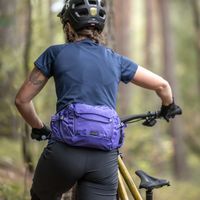
What’s better for riding: Hip pack vs. Backpack
Water, tools, snacks, layers: where it all goes depends on how long and how rough your day is.
Buying Guide
MIPS, Koroyd, and a dial you can't feel: here's what actually matters when you're picking a lid.
A helmet is the one piece of kit you genuinely hope never gets used the way it was designed to. But when it does, the difference between a good one and a great one is measured in concussions you didn't get. Here's how to sort through the marketing and find a helmet that actually fits your riding and your head.
Section 01
Helmet categories exist for a reason: coverage, weight, and ventilation all trade off against each other depending on what you're doing.
Lightweight, well-ventilated, minimal coverage at the back of the head. You're climbing a lot and generating heat, so airflow matters more than maximum coverage. Lower-speed crash risk means manufacturers can shave grams without sacrificing the protection you actually need.
The middle ground, and honestly where most Fernie riders should be looking. More rear and temple coverage than an XC lid, still reasonably light, still vented enough for the climb back up. If you only own one helmet, make it a trail helmet.
Full coverage including your jaw and chin. Heavier, hotter, and built for the speeds and consequences of bike park laps and steep, technical descents. Not something you want to wear on a 1,500m climb, but non-negotiable if you're spending your day on a chairlift-served bike park.
This matters more than most riders think. The foam liner inside a helmet, usually EPS (expanded polystyrene), is a one-hit wonder. It's designed to crush and absorb impact energy exactly once. After a crash, that foam may be compressed or cracked in ways you can't see from the outside, even if the shell looks perfectly fine. Replace it. Don't wait to see if it "still feels okay."
Even without a crash, most manufacturers recommend replacing a helmet every three to five years. UV exposure, sweat, and general wear degrade the foam and shell over time, and the straps and buckles wear out too. If your helmet has seen a few Fernie summers of sun and sweat, it's earned its retirement.
Section 02
Most crashes aren't a clean, straight-on hit. They're glancing impacts at an angle, which create rotational forces on your head and brain. Standard foam helmets are very good at managing direct, straight-line impacts, but rotational forces are a different problem, and that's where the newer protection systems come in.
MIPS adds a low-friction layer inside the helmet that sits between the foam and your head, allowing the helmet to slide slightly relative to your skull on an angled impact. That small amount of rotational slip is what reduces the rotational force transmitted to your brain, the kind of force linked to concussions. Most major brands (Fox, Troy Lee, Giro, Bell, Smith, Specialized, Sweet Protection) now offer MIPS versions across their MTB lineups.
How do you know if a helmet has MIPS? Look for the yellow MIPS sticker, usually on the back of the helmet, or check the product spec sheet. Note that there are several different MIPS systems (MIPS C2, MIPS Air Node, MIPS Integra and others) depending on how the helmet is built. They all serve the same rotational-protection purpose, just packaged differently for the helmet's shape and ventilation needs.
As an example, Smith's Session MIPS and Engage MIPS both use MIPS Air Node, which is built into the helmet's padding rather than added as a separate sliding liner. Worth a look if you've found older-style MIPS liners feel bulky or change how a helmet sits on your head.
Instead of (or alongside) traditional EPS foam, Koroyd uses a honeycomb of welded plastic tubes that crumple instantly and consistently on impact, similar in concept to a car's crumple zone. Because the structure is around 95% air, it also ventilates exceptionally well, which is the rare case of a safety feature that doesn't cost you anything in breathability. The more Koroyd in a helmet, the more of that crumple-zone absorption you're getting. Smith is currently the main brand building it into snow and bike helmets.
Neither MIPS nor Koroyd is "better" in an absolute sense. They solve overlapping but slightly different problems, and some helmets even combine elements of both. The honest takeaway: a helmet with one of these systems is a meaningful upgrade over one with neither, all else being equal.
Section 03
The best safety tech in the world doesn't help if the helmet sits crooked or you stop wearing it because it's uncomfortable. Fit varies noticeably between brands, so try before you buy where you can.
| What to check | Why it matters |
|---|---|
| Retention system | Most helmets use a rear dial (often a BOA-style dial) to cinch the cradle around the back of your head. A good retention system lets you fine-tune fit without the helmet feeling clamped on. |
| Pad thickness | Brands shape their internal pads differently: some run higher-volume, some lower. If a helmet feels like it's sitting too high or too low no matter how you adjust the dial, it's probably the wrong shape for your head, not the wrong size. |
| Strap adjustment | Look for a simple, secure buckle and an adjustable splitter near your ear. You want the straps to form a snug "V" without digging in. |
| Weight distribution | Shake your head side to side and front to back with the straps undone (carefully). A well-fitted helmet shouldn't shift dramatically. |
Different brands fit differently because they're built on different head shapes: rounder, more oval, narrower at the temples. If one brand never feels quite right no matter the size, it's worth trying a completely different brand before assuming you just need a bigger or smaller size.
Section 04
Once safety and fit are sorted, the features below are what separate a good helmet from one you'll actually love wearing every ride.
None of these features make a helmet safer on their own, but they make you more likely to wear it properly, adjusted correctly, every single ride. That's worth something too.
We carry a range of trail, XC, and full-face helmets, including MIPS and Koroyd-equipped models from Smith, Abus, Fox Head, and Sweet Protection, think Smith's Session MIPS and Engage MIPS, Abus's trail lineup, Fox's Dropframe Pro MIPS and Proframe full-face, and Sweet Protection's Trailblazer and Bushwhacker. Browse our current helmet lineup online or come try a few on, and we'll help you match the protection system and fit to your head shape.
Pick the category that matches how you actually ride (trail covers most people in Fernie), look for MIPS or Koroyd as a baseline safety upgrade, and prioritize fit over feature lists. Replace it after a crash, or every few seasons regardless.
Come try a few on in-store. Head shapes are personal, and the only way to know if a helmet's right is to put it on.