
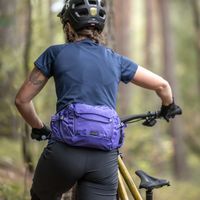
What’s better for riding: Hip pack vs. Backpack
Water, tools, snacks, layers: where it all goes depends on how long and how rough your day is.
Buying Guide
Pins, cleats, and float: the contact point between you and the bike, broken down.
Two bolts, one decision, and a surprising amount of opinion attached to it. Flat vs. clipless is one of those debates every rider eventually has with themselves, usually after watching someone else clean a section they couldn't. The honest answer is that both systems work. They just reward different things. Here's what each actually does for your riding.
Section 01
A flat pedal works through friction: grippy pins on the pedal body bite into the sole of a soft-rubber shoe, holding your foot in place without locking it down. Nothing clicks, nothing releases. You stay on by standing on it correctly.
Without a mechanical connection, sustained power transfer (think long climbs or sprint efforts) relies entirely on technique and pin grip. Pins also have a habit of introducing themselves to your shins if your foot slips, a rite of passage more than a dealbreaker, but worth knowing about.
Pin count and placement matter as much as the pedal body itself. More pins around the perimeter generally means more grip, but too aggressive a pin pattern with the wrong shoe can make repositioning your foot harder than it should be. OneUp Components' composite pedals are a good example of a thin-profile platform with an aggressive, fully adjustable pin layout.
Section 02
A bit of a misnomer: "clipless" pedals actually clip you in, via a cleat bolted to the sole of a compatible shoe that locks into a spring-loaded mechanism on the pedal. The name comes from the fact that they replaced old-school toe clips and straps.
There's a learning curve to clipping in and out smoothly, and a brief period where everyone (yes, everyone) has a slow-speed tip-over while their brain relearns how to disengage. Cleat and shoe wear also affects release tension over time, so it's worth checking periodically.
New to clipless? Set the release tension to its lowest setting to start. You can always increase it once unclipping becomes second nature. Starting too tight is the most common cause of that first slow-speed tumble.
Section 03
"Pedal size" doesn't just mean shoe size. It's about how much pedal body is actually under your foot, and that varies a lot more than most riders realize, especially on flats.
Flat pedal bodies typically range from around 95mm to 120mm wide and 100-115mm front-to-back, with a thickness (stack height) anywhere from 10mm to 20mm. A larger platform spreads pressure across more of your foot, which can reduce hot spots on long days and gives a bigger margin for error when your foot shifts mid-corner. A smaller platform weighs less and can offer more ground clearance on rocky, technical trails where pedal strikes are a real concern.
As a rough guide, a pedal body that's noticeably narrower than your shoe means the edges of your foot are unsupported. That's fine for some riders, but it can feel vague underfoot if you're used to a fuller platform. Riders with larger feet (US 11+) often prefer the larger end of the size range; smaller-footed riders or those prioritizing cornering clearance often do well with a more compact platform. There's no universal "correct" size: it's a function of foot size, riding style, and personal feel. The Crankbrothers Stamp, for instance, comes in Small (100mm x 100mm) and Large (110mm x 115mm) versions of the same pedal, a good illustration of how much platform size can vary within one model line.
Many flat pedals are concave: the platform dishes slightly toward the pedal axle, which helps cup your foot and increase the wrap-around contact with the pins. More concavity generally means more grip and a more "locked in" feel; a flatter platform feels more neutral and makes repositioning your foot easier.
Clipless pedals also come in different body sizes. Some (often XC-oriented) are minimal, little more than the cleat mechanism, while trail and enduro-focused clipless pedals add a small platform around the cleat for extra support, particularly useful when your foot isn't perfectly clipped in on rough terrain. If you've found clipless pedals uncomfortable in the past, a larger-platform clipless pedal is worth trying before writing off the system entirely.
Section 04
| If you're... | Consider |
|---|---|
| New to mountain biking | Flats. Build confidence and technique without worrying about unclipping in a tense moment. |
| Working on technical skills | Flats. The ability to reposition your feet and bail instantly is valuable while you're learning to manual, jump, or ride steep tech. |
| Racing or doing long endurance days | Clipless. The efficiency gain on sustained efforts is real, and consistent foot position helps over long days. |
| Riding a mix of everything | Either. Plenty of experienced riders run flats specifically because they prefer the feel, not because they "haven't graduated" to clipless. It's not a hierarchy. |
One more thing worth saying clearly: flats are not a beginner system you outgrow. A lot of skilled, fast riders, including pros in disciplines like enduro and freeride, run flats by choice because the feel and bail-out ability suit how they ride.
Section 05
Our flat pedal lineup spans compact and full-size platforms from Deity, Crankbrothers, OneUp Components, and RaceFace, including the Crankbrothers Stamp in both Small and Large platform sizes and OneUp's slim composite and aluminum pedals, and our clipless options include Crankbrothers, OneUp, Look, and TIME systems with both minimal and platform-style bodies. See what's in stock online or come stand on a few in the shop. Platform size is one of those things that's hard to judge without trying it.
Neither system is "more legit" than the other. They suit different riding goals and, frankly, different feels underfoot. If you're not sure, start with flats while you build skills, and revisit clipless once you know what you're looking for.
Come in and we'll talk through your setup: shoes, cleats, and pedal compatibility included.